Seerror · Defence-tech R&D
Vajradrishti
Project Drishti-7 · India-first aerial awareness
“AI sees. Soldier decides. India protects.”
Vajradrishti (“the thunderbolt’s sight”) is Seerror’s concept for soldier-centric aerial awareness, built in India. The idea is simple: a soldier on patrol should never be the last to know what is just over the ridge. A small AI drone watches the area around them, makes sense of what it sees, and tells the soldier in plain words - while every decision stays with people.
It is planned in three stages. Each stage only begins once the one before it has proven itself.
A personal AI companion drone for the soldier on patrol. It follows, watches, and sends short, honest alerts to the soldier’s watch or phone.
In developmentReconnaissance on request. The soldier asks the drone to look ahead - a route, a ridgeline, a river crossing - and it reports back.
ConceptWider awareness for commanders: several drones mapping hard-to-reach areas, so decisions are made earlier and with better information.
ConceptStage 1 · in development
Meet GARUDA - Garuda sees. Garuda thinks. The soldier decides.
GARUDA is an on-device AI surveillance drone. All of its AI is designed to run on the drone itself - no cloud, no ground server, no internet needed. It watches with a day camera and a thermal camera, works out what matters, and tells the soldier. It never fires, never engages and never attacks: it has no such function at all.
An example of the kind of alert GARUDA writes: it says “gun-like”, never “gun”; it never says “enemy”; it gives its confidence; it leaves the decision to the soldier.
Concept airframe
Built to watch for hours, and recharge itself
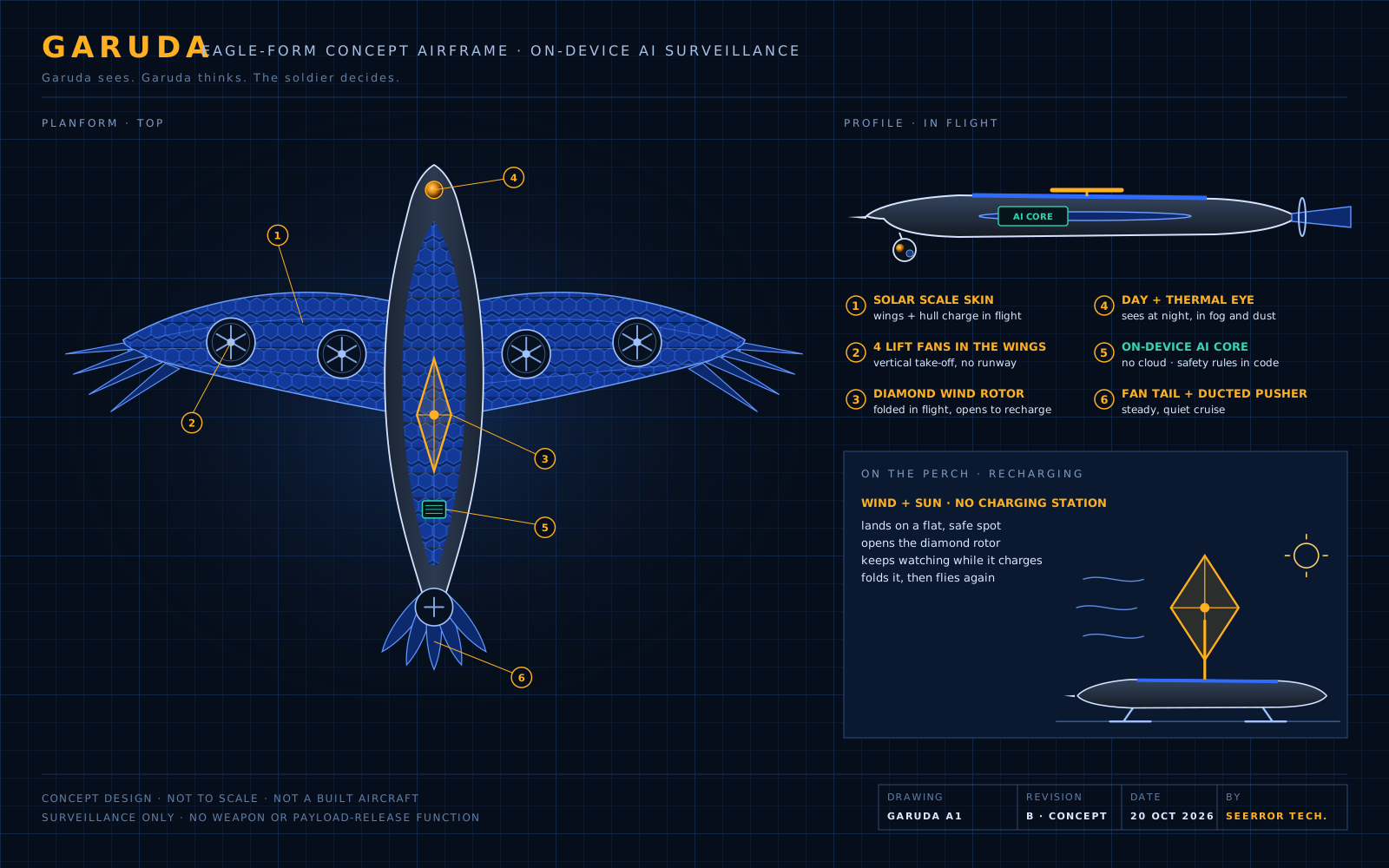
Concept design, not to scale and not a built aircraft. It has no weapon or payload-release function.
GARUDA at night
What the eye misses, GARUDA sees
Simulated visual, generated in code - not real footage and not a real detection. On the left, a moonless border at 2 a.m. as the eye sees it. On the right, the same scene through a thermal camera: GARUDA marks each person, calls a long object “gun-like … not confirmed”, and leaves the decision to the soldier.
From the drone to the soldier’s wrist
One alert, in plain words - the soldier decides
Simulated visual - not real footage. The alert texts on the watch are produced by GARUDA’s own decision rules for this scene. Nothing is “confirmed” by the drone: it says what it sees, how sure it is, and keeps tracking from a distance while the soldier decides.
Built on
Six principles that do not change
The drone informs. People decide every response. The trigger is always human.
Watching, following, zooming, switching to thermal, returning to charge - nothing more. There is no fire or attack action to misuse.
Works where there is no network, and keeps what it sees on the device instead of a distant server.
Confidence and doubt are stated plainly. Fewer false alarms means soldiers can trust the alerts that matter.
The rules that keep it safe are simple, fixed and checkable - not left to the AI.
A solar skin and a fold-out wind rotor that opens only after landing, so it can recharge in the field.
Why India-first
Designed and built in India
Surveillance technology that depends on foreign servers, foreign software updates or foreign supply chains can be slowed or switched off when it matters most. Vajradrishti starts the other way round: AI that runs on the device, software written in India, and a design that can be reviewed, maintained and improved at home.
Where it stands
Honest status
GARUDA’s object detection works on a live camera, and its on-board decision AI is being trained and tested in simulation. Every result, pass or fail, is shared openly.
Testing on a drone computer, then careful step-by-step supervised flights. Stages 2 and 3 come only after Stage 1 has proven itself.
Questions
Common questions
Is GARUDA a weapon?
No. It watches, thinks and alerts. It has no fire, attack or targeting function of any kind, and every decision that matters is made by a person.
Does it need the internet or a cloud server?
No. Its AI is designed to run entirely on the drone, so it keeps working where there is no network.
Does it work at night?
That is the job of its thermal camera and a separate night-vision AI model, which is being trained now.
Is it deployed or for sale?
No. It is in development and has not been flight-tested in the field.
Who is building it?
Seerror, an independent Indian AI company in Bengaluru founded by Jay Tiwari. We welcome conversations with qualified Indian defence-research and industry partners.